About US
Marine Police Officers also conduct search and rescue operations, enforce boating safety laws, respond to emergency calls, investigate boating accidents and criminal activity, and provide counter-terrorism patrols to our military installations, shipyards, nuclear power plants, and other high-value maritime assets.
The highly trained men and women of the Virginia Marine Police are dedicated to providing the highest standard of law enforcement service to the citizens of the Commonwealth and visitors.
Whether checking recreational fishing licenses, inspecting commercial fishermen for compliance, investigating boating accidents or conducting educational programs, Marine Police Officers provide a multitude of important public services. Education and enforcement forge an important tool that ensures the success of the agency's mission.
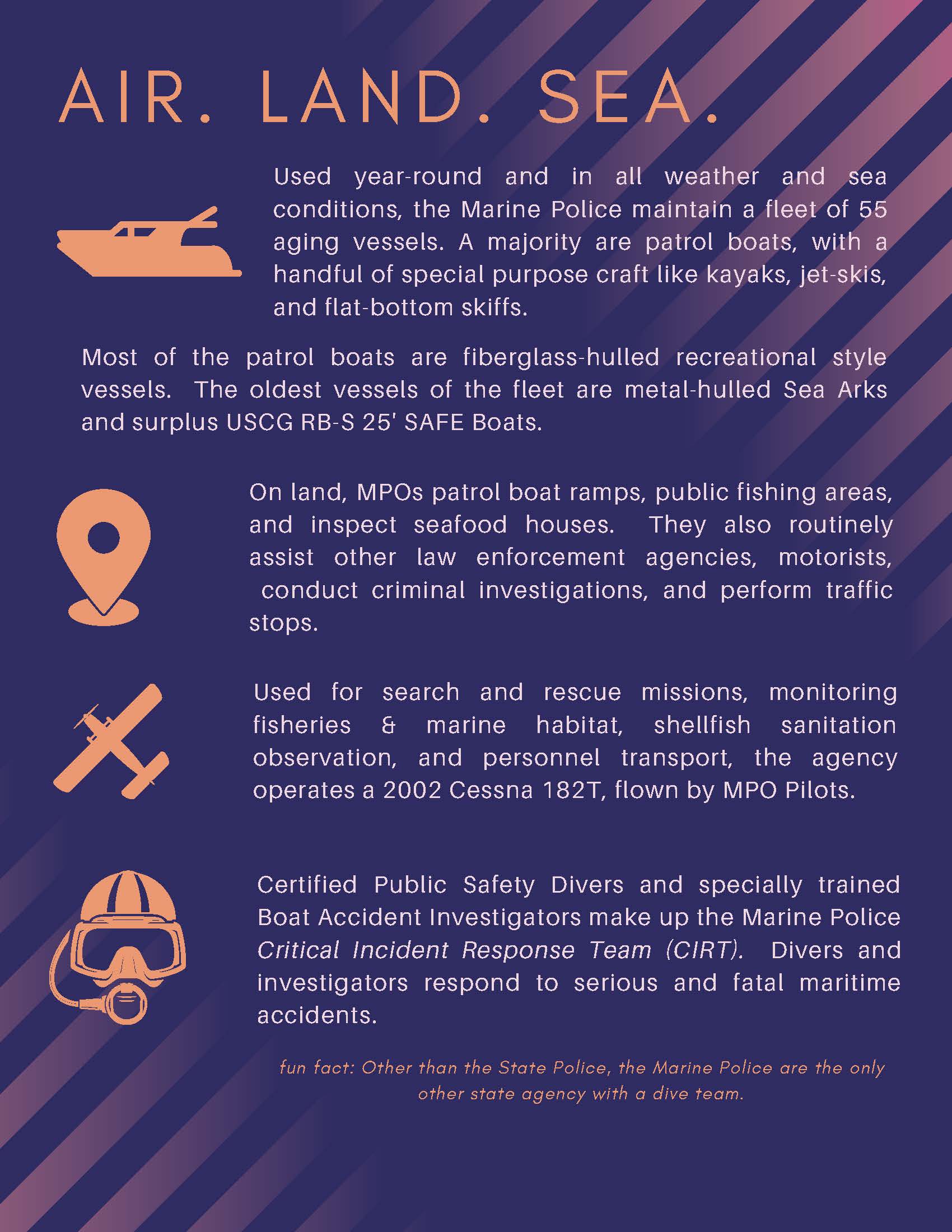
Uniform patrol is the cornerstone of the law enforcement division. To maximize deployment and to achieve greater flexibility in personnel, Marine Police Officers use a number of different vessels, vehicles and air support for law enforcement patrols.
Our Special Investigative Unit has a proven track record of success.
The marine mechanical staff located at the Operations Station ensures police vessels are kept in top running condition.
The communications division fields thousands of calls a year for a variety of dispatch services ranging in nature from a simple question pertaining to a regulation to dispatching police personnel to boating accidents.
Virginia Marine Police Officers are required to complete a state-mandated basic police academy. They then undergo a rigorous in-house training regime to learn maritime issues their specialized jobs require, including seafood and fishing regulations, boat handling, boat safety, and water rescue techniques.
To maintain their law enforcement certifications, each officer receives additional, on-going training every two years to maintain their proficiency in small arms, driving, boating under the influence recognition, first-aide and other areas. Roughly 20 percent of Virginia Marine Police Officers are certified training instructors.
New officers are also required to complete the Marine Law Enforcement Training Program held at the Federal Law Enforcement Training Center in Glynco, Georgia.
Through a cooperative law enforcement agreement between the Virginia Marine Resources Commission, the National Marine Fisheries Service and the U.S. Fish & Wildlife Service, Marine Police Officers are deputized to enforce federal fish and wildlife laws. The strong bond between the agencies has proven to be a model in cooperative law enforcement.
The Virginia Marine Resources Commission also is part of a cooperative agreement with the United States Coast Guard that allows the Virginia Marine Police to enforce federally designated safety and security zones.
The men and women of the Virginia Marine Police serve a valuable, specialized role in public safety and fishery management, and continue a proud tradition of service, valor and professionalism in one of the oldest law enforcement agencies in the Commonwealth.
Boating Safety
Boating safety is a prime concern of the Virginia Marine Police.
We conduct thousands of inspections each year to ensure boaters have the required safety equipment on hand when they are on the water, and conduct search and rescue operations when problems arise.
In addition to vessel safety inspections, the Virginia Marine Police participate in boating while intoxicated check points with the U.S. Coast Guard.
Shellfish Handling
The Virginia Marine Police work hard to ensure the shellfish you eat from state waters is safe.
Officers inspect Virginia oyster and clam harvests to ensure the shellfish brought to market are handled properly, kept cool and are not inadvertently taken from polluted waters.
Marine Police Officers also post the seasonal condemnation signs in waters determined to by the Virginia Department of Health (VDH) to have elevated bacteria levels.
Their constant efforts protect both consumers and the economically valuable shellfish industry has earned the Virginia Marine Police top marks for many years from the Interstate Shellfish Sanitation Conference, which was formed in 1982 to foster and promote shellfish sanitation through the cooperation of state and federal control agencies, the shellfish industry, and the academic community.
Established in 1875 as the Virginia Fish Commission, the Virginia Marine Resources Commission (VMRC) is one of the oldest agencies in Virginia State Government. Until the last decade, shellfish regulation has dominated much of the agency's activities because of the economic and cultural importance of the oyster industry. Private leasing of State bottom for the planting and propagation of oysters appears to have begun before 1875, but it was not until 1884 that the Commonwealth set up the Board of the Chesapeake to handle the regulations of the oyster industry. Public oyster grounds were mapped (the so-called Baylor Survey) during 1892-1895.
The Fish Commission, which at that time dealt with both fresh and saltwater fisheries issues, was consolidated with the Board of the Chesapeake in 1898 to form the Board of Fisheries, later the Commission of Fisheries, which was given the task of managing all shellfish and finfish issues statewide.
The Habitat Management Division of the Commission traces its origin to 1962 when the responsibility for permit encroachments in or over State-owned submerged lands was transferred from the Office of the Attorney General to the Commission of Fisheries. This made marine management in Virginia unique in that living resources, and the habitat on which they depend, came under the jurisdiction of the same agency.
A legislative study commission in 1967 recommended a broadened mission resulting in the agency being renamed the Virginia Marine Resources Commission in 1968 by an act of the Virginia General Assembly. The Virginia Wetlands Act was passed in 1972 and placed under the management of VMRC, as was the 1980 Coastal Primary Sand Dune Protection Act. In 1982, the General Assembly broadened the 1972 Wetlands Act to include non-vegetated wetlands. In 1984, a distinct Fisheries Management Division was created and its authority over fisheries issues was strengthened.